


The lord whose form is OM, Ganesha and the rat, Married or celibate?
 Ganesha is also described as Omkara or Aumkara, that is having the form of Om. The shape of his body is a copy of the outline of the Devanagari letter which indicates the celebrated Bija Mantra. For this reason, Ganesha is considered the bodily incarnation of the entire Cosmos, He who is at the base of all of the phenomenal world (Vishvadhara, Jagadoddhara). Moreover, in the Tamil language, the sacred syllable is indicated precisely by a character which recalls the shape of the elephant's head of Ganesha.
 Ganesha and the rat
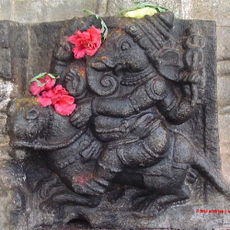 Ganesha riding on his rat. Note the flowers offered by the devotees. A sculpture at the Vaidyeshwara temple at Talakkadu, Karnataka, India
According to one interpretation, Ganesha's divine vehicle, the rat or mooshikam represents wisdom, talent and intelligence. It symbolizes minute investigation of a cryptic subject. A rat leads a secret life below the ground. Thus it is also a symbol of ignorance that is dominant in darkness and fears light and knowledge. As the vehicle of Lord Ganesha, a rat teaches us to remain always on alert and illuminate our inner-self with the light of knowledge.
Both Ganesha and the Mooshak love modaka, a sweet dish which is traditionally offered to them both during worship ceremonies. The Mooshak is usually depicted as very small in relation to Ganesha, in contrast to the depictions of vehicles of other deities. However, it was once traditional in Maharashtrian art to depict Mooshak as a very large rat, and for Ganesha to be mounted on him like a horse.
Yet another interpretation says that the rat (Mushika or Akhu) represents the ego, the mind with all of its desires, and the pride of the individual. Ganesha, riding atop the rat, becomes the master (and not the slave) of these tendencies, indicating the power that the intellect and the discriminative faculties have over the mind. Moreover, the rat (extremely voracious by nature) is often depicted next to a plate of sweets with his eyes turned toward Ganesha while he tightly holds on to a morsel of food between his paws, as if expecting an order from Ganesha. This represents the mind which has been completely subordinated to the superior faculty of the intellect, the mind under strict supervision, which fixes Ganesha and does not approach the food unless it has permission.
Lastly it is a very evocative presentation of how humble and modest one should be. Ganesha in spite of his huge physical, mental and intellectual prowess conducts and carries himself so lightly that he can very well be carried by a very very small (compared to the size of Ganesha) and insignificant being-the rat.
Married or celibate?
It is interesting to note how, according to tradition, Ganesha was generated by his mother Parvati without the intervention of her husband Shiva. Shiva, in fact, being eternal (Sadashiva), did not feel any need to have children. Consequently, the relationship of Ganesha and his mother is unique and special.
This devotion is the reason that the traditions of southern India represent him as celibate (see the anecdote Devotion to his mother). It is said that Ganesha, believing his mother to be the most beautiful and perfect woman in the universe, exclaimed: "Bring me a woman as beautiful as she and I will marry her."
In the north of India, on the other hand, Ganesha is often portrayed as married to the two daughters of Brahma: Riddhi (intellect) and Siddhi (spiritual power). Popularly in north India Ganesha is accompanied by Sarasvati (goddess of culture and art) and Lakshmi (goddess of luck and prosperity), symbolizing that these qualities always accompany he who has discovered his own internal divinity. Symbolically this represents the fact that wealth, prosperity and success accompany those who have the qualities wisdom, prudence, patience, etc. that Ganesha symbolises.
There is another mythology, especially in Bengal, which goes in that Ganesha is married to the Kalabou. The Kalabou is nothing but a banana tree draped in traditional white with a Bengali saree with a red border. The story goes that, when Ganesha was supposed to marry, one day when he came home, he saw his mother Durga eating with all her ten hands. Shocked, he asked why is she doing it. Durga replied that if, after Ganesha marries, his wife would not give Durga any food, so Durga is eating to her heart's content with all ten hands. Feeling very sad, Ganesha decided that he would marry a banana tree or Kalabou so that her mother never has any worries about food, as a banana tree cannot stop her from eating.
In the early hours of Saptami, the kalabou is taken for a bath to the Holy Ganges. Water from the Ganges accompanied with Dhak and Kanshi finishes the bathing ceremony. After the bathing ceremony she is adorned in a red-bordered white sari and vermilion is smeared on its leaves. She is then placed on a decorated pedestal and worshipped with flowers, sandalwood paste, and incense sticks. Later she is placed on the right side of Lord Ganesh. This is the reason she is popularly known as Ganesh's wife.
{}{}{}{}om om om {}{}{}{}
Want fun then why wait? Click on any one of URLhttp://blog4people.coz.in http://jokes4children.coz.in http://adsense.coz.in http://kannada.coz.in http://ourmysore.coz.in http://wowbangalore.coz.in http://wowchennai.coz.in http://bhshistory.coz.in http://karaga.coz.in http://hampi.coz.in http://coorg.coz.in http://ganesha.coz.in http://yakshagana.coz.in http://safeeyes.coz.in
posted by SaTiSh | 8:51 PM


0 Comments:
Post a Comment
<< Home